
Stop Saying “We” When You Mean “You”
Apr 15, 2026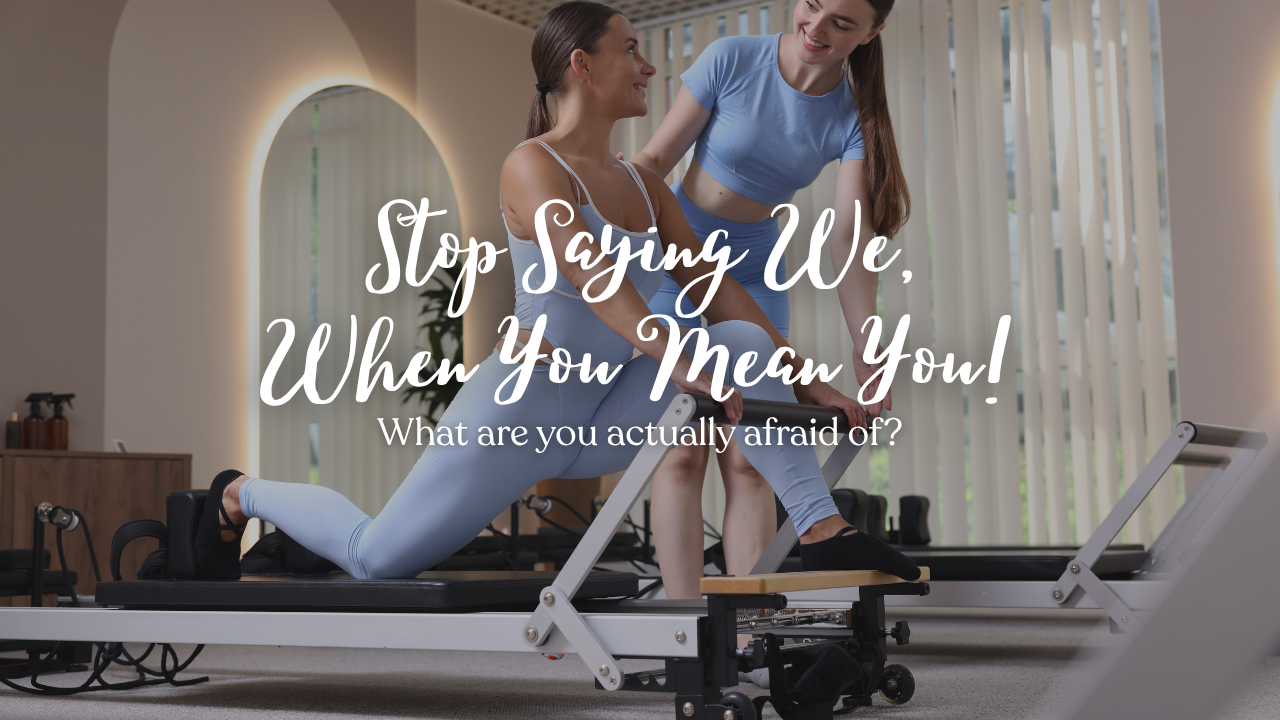
What are you actually afraid of?
Yesterday I produced a social media post on the Pilates Pro handle that has gone viral.
In that post, I talked about something that most people are doing without even realising.
Instructors standing at the front of the room, not doing the exercise, teaching other people on the reformer… and saying:
“We’re going to put our feet in straps.”
“We’re going to put our hands in straps.”
“We’re going to lift our hips.”
But you’re not.
They are.
So why are you saying “we”?
This is not about pronouns.
This has got nothing to do with pronouns.
This is about language, leadership, and what is actually happening to the way we speak as professionals.
Why are you using “we” when you mean “you”?
Let’s just say it straight.
You’re not confused about English.
You know the difference between we and you.
So why are you doing it?
Because “we” softens things.
Because “we” doesn’t make you sound like you’re telling someone what to do.
Because “we” makes you feel like you’re being inclusive.
Because “we” makes you feel like you’ll be liked.
And this is where we need to go deeper.
The fear of sounding like a dictator
There is this underlying fear that if you speak directly, you’re going to sound like a dictator.
So instead of saying:
“Put your feet in straps.”
You say:
“We’re going to put our feet in straps.”
It feels nicer.
But here’s the truth:
Good teaching is not about avoiding sounding like a dictator.
Good teaching is about being clear.
You are the teacher.
You are directing movement.
You are guiding someone’s body.
Stop pretending you’re not.
Wanting to be liked by everyone
There is a deep desire now for instructors to be liked by everyone.
To be approachable.
To be warm.
To be friendly.
To not offend.
To not come across as too strong.
So language gets softened.
But what happens is that it also gets watered down.
And watered-down language leads to watered-down teaching.
You don’t need to dilute your instruction to be a good person.
You need to be clear and respectful.
They are not the same thing.
The idea of being “inclusive”
Now this is where I really want to challenge you.
Because the word inclusive gets thrown around a lot.
And on the surface, it is a well-meaning idea.
But it has been hijacked.
There is this push to make everything for everyone.
To make everyone feel included all the time.
To make sure no one feels like they are being directed, corrected, or singled out.
And what happens?
Everything becomes vague.
Everything becomes general.
Everything becomes… nothing.
Pilates is not for “everyone” in the way people think it is
Yes, Pilates can be accessible.
Yes, people from all walks of life can benefit from it.
But when you are teaching a class, you are not teaching “everyone”.
You are teaching the people in front of you.
That is exclusivity.
And exclusivity has somehow become a dirty word.
People are scared to use it in case they come across as non-inclusive.
But here’s the truth:
If you can speak and teach exclusively to the body in front of you in the moment, then you are serving that person fully and wholly.
That is the job.
“We” is an extension of that fear
“We” is part of this whole thing.
It’s part of:
- not wanting to be exclusive
- not wanting to stand in authority
- not wanting to sound direct
- not wanting to risk not being liked
So instead of saying:
“Place your feet in straps.”
You say:
“We’re going to place our feet in straps.”
But again…
You are not.
They are.
The deterioration of language
Now let’s go even deeper.
Because this is not just about Pilates.
This is about what is happening to language in general.
I actually wonder:
Are people even reading books anymore?
Or are they just scrolling?
Because here’s what the data is showing.
In Australia, recent reading reports show that yes—many people will say they’ve read a book in the last year.
But let’s be honest…
One book a year is not reading.
That is not immersion.
That is not practice.
That is not developing language.
And when you look deeper, the numbers get more concerning.
Only around 17% of people read daily.
Seventeen percent.
That means the vast majority of people are not engaging with language in any kind of consistent, structured way.
And in younger groups, it drops even further.
In the UK, only 18.7% of young people read daily for pleasure, and reading enjoyment has dropped to some of the lowest levels recorded.
So what does that mean?
It means people are consuming language like this:
- short captions
- reels
- snippets
- podcasts
- fast, fragmented ideas
And they are not sitting with:
- structured sentences
- long-form writing
- well-developed thought
Reading is what teaches you how to speak
Reading books is what helps you understand how to formulate sentences.
It helps you appreciate literature.
It helps you understand where language comes from.
It gives you structure.
It gives you rhythm.
It teaches you:
- who is doing the action
- what the action is
- how a sentence actually lands
And when that disappears…
Language becomes:
- sloppy
- vague
- repetitive
- padded
Which is exactly what we are hearing in Pilates classes.
Understanding where language comes from matters
If you don’t understand language, you can’t use it properly.
If you don’t understand how a sentence is formed, you won’t know when it’s off.
And “we’re going to…” when you’re not doing the thing…
It’s off.
This is what professionalism actually looks like
Being a professional is not just knowing exercises.
It’s not just knowing choreography.
It’s how you speak.
It’s how you communicate.
It’s how you hold yourself in the room.
And language is a massive part of that.
Because language shapes how you are perceived.
It shapes whether you are respected.
It shapes whether people trust you.
What should you say instead?
Keep it simple.
Instead of:
“We’re going to put our feet in straps.”
Say:
Place your feet in straps.
Instead of:
“We’re going to press the carriage out.”
Say:
Press the carriage out.
Instead of:
“We’re going to lift our hips.”
Say:
Lift the hips.
Or:
Place your feet in straps when you’re ready.
Still clear.
Still respectful.
Still professional.
Final thought
This isn’t about being harsh.
It’s not about being perfect.
It’s about being honest in your language.
You are the teacher.
They are the students.
There is nothing wrong with that.
So stop hiding behind “we”.
Stop diluting your language.
Stop trying to be everything to everyone.
And start speaking like a professional.
Because if you want to be recognised and respected in this industry,
then you need to sound like it.
Place the feet in straps.
Press the carriage out.
Return with control.
That’s it.
That’s the standard. And that is exactly what one of the Pilates Pro Academy teaches our student instructors. Communication. Because if we want to be recognised as professionals we absolutely must learn how to communicate with authority.
Join the Pilates Muse Publication
Explore the world of Pilates through our bi-weekly newsletter, carefully crafted to bring the essence of Pilates directly to your inbox.
Each issue is thoughtfully curated to inspire, educate, and connect you with the timeless principles of Pilates.
See you inside!
We hate SPAM. We will never sell your information, for any reason.

